Claude Fable 5 shipped on June 9, 2026, and the price tells you what Anthropic thinks it is for: $10 per million input tokens and $50 per million output tokens through the Claude API (Anthropic). That is not a default autocomplete model. It is the model you reach for when the task is long, expensive to get wrong, and worth a stronger pass.
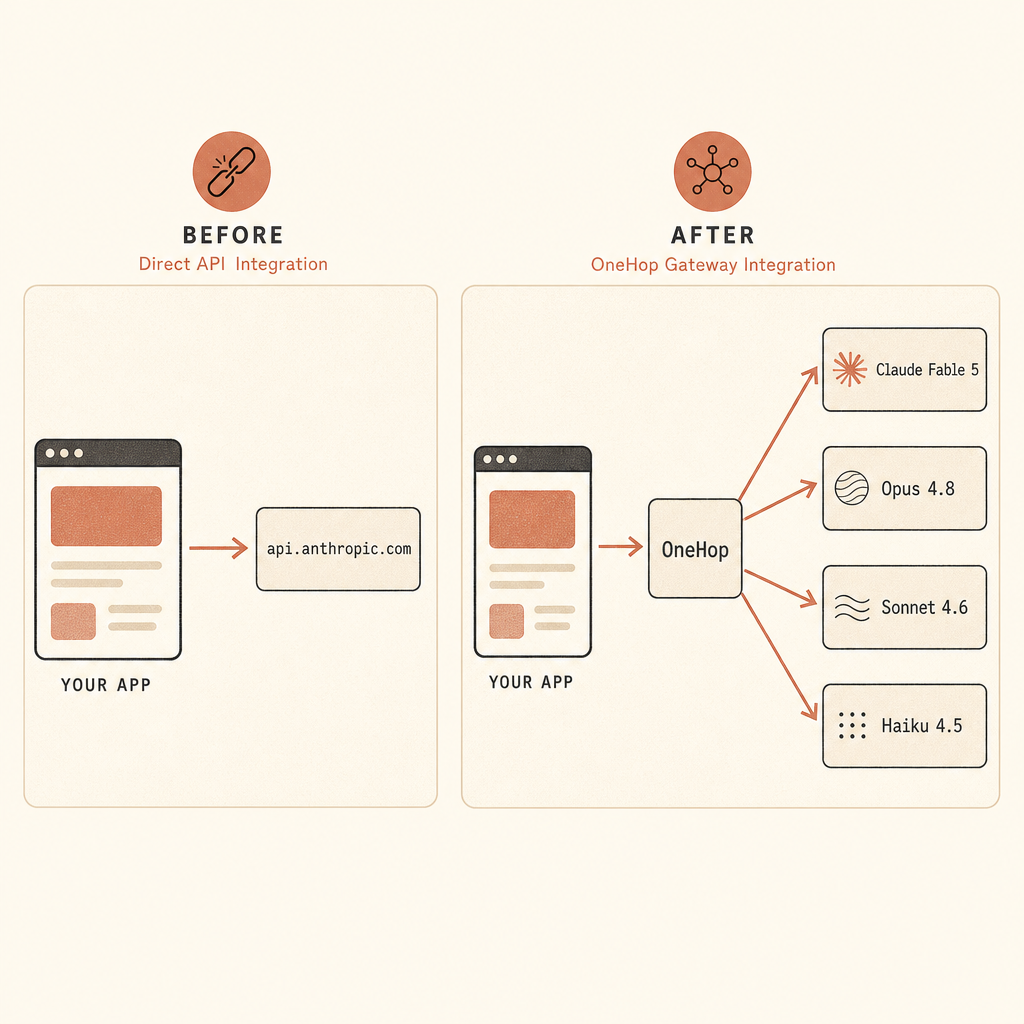
The nice part: if your app already uses the Anthropic SDK, you do not need to rewrite your client layer to try it through OneHop. You can keep client.messages.create(...), keep the Anthropic message shape, and point the SDK at OneHop’s Anthropic-compatible endpoint.
Why Fable 5 Changes the Routing Conversation
Anthropic describes Claude Fable 5 as a “Mythos-class” model made safe for general use, with capabilities above any model it had previously made generally available (Anthropic). The model ID for the Claude API is claude-fable-5, and Anthropic says it is available through the Claude Platform and cloud marketplaces (Anthropic).
Two details matter for developers.
First, Fable 5 is priced like a top-tier model: $10/M input and $50/M output, with Anthropic’s 90% input-token discount for prompt caching still applying (Anthropic). Anthropic also states that US-only inference is available at 1.1x pricing for input and output tokens (Anthropic).
Second, Fable has built-in safeguards. Anthropic says cybersecurity, biology and chemistry, or distillation requests flagged by classifiers are automatically handled by Claude Opus 4.8 instead, and early data showed more than 95% of Fable sessions had no fallback (Anthropic). If your product touches security research, bio, or chem workflows, treat this as product behavior, not an edge case.
That is where a gateway earns its keep. You usually do not want every request going to the most expensive model. You want one integration point, a single key, clean billing, and the option to route normal work to cheaper models while saving Fable for the prompts that justify it.
What OneHop Gives You
OneHop positions itself as an AI gateway: one account, one API layer, and access to models across providers. Its homepage says it supports OpenAI, Anthropic, and Vertex protocols, and that you can “point base_url at OneHop and keep your existing SDKs and code” (OneHop).
For Claude Fable 5 specifically, OneHop lists the model as:
| Item | Current value |
|---|---|
| OneHop model name | anthropic/claude-fable-5 |
| Context | 1M tokens |
| Capabilities listed | vision, reasoning, tool calling, coding, prompt cache |
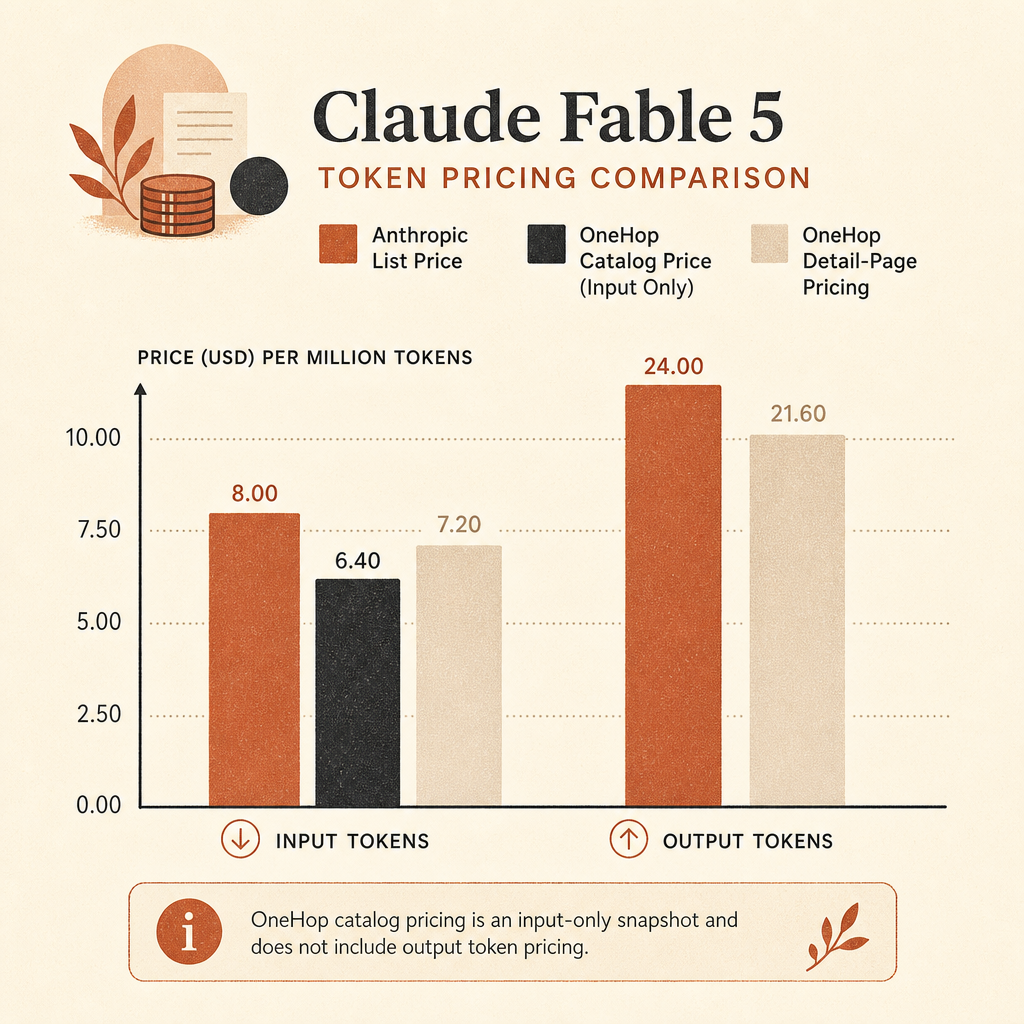
| Anthropic list price | $10/M input, $50/M output |
| OneHop catalog price | $7/M input, listed as “Save 30%” |
| OneHop detail-page price | $5/M input, $25/M output, “Verified 2026-06-10” |
Sources: OneHop’s model catalog lists Claude Fable 5 at 1M context and $7.00/M with “Save 30%” (OneHop models). The Fable detail page currently shows $5.00/M input and $25.00/M output, with cache read at $0.500/M and cache write at $6.25/M, verified 2026-06-10 (OneHop Fable 5).
That discrepancy is worth calling out because prices move. The safe claim is: OneHop is currently advertising Claude Fable 5 below Anthropic list price, with at least a 30% discount shown in its live model catalog. Check the model page before you ship a pricing assumption.
OneHop also offers new accounts $10 in free credit with no card required on the Fable page (OneHop Fable 5). If you just want to smoke-test the integration, start at Claude Fable 5 on OneHop or start with $10 free.
The Drop-in Anthropic SDK Setup
Install the official Anthropic Python SDK:
python -m venv .venv
source .venv/bin/activate
pip install anthropic
Set your OneHop key:
export ONEHOP_API_KEY="oh_your_key_here"Now use the same Anthropic SDK shape you already use. The important line is base_url.
import os
from anthropic import Anthropic

client = Anthropic(
    api_key=os.environ["ONEHOP_API_KEY"],
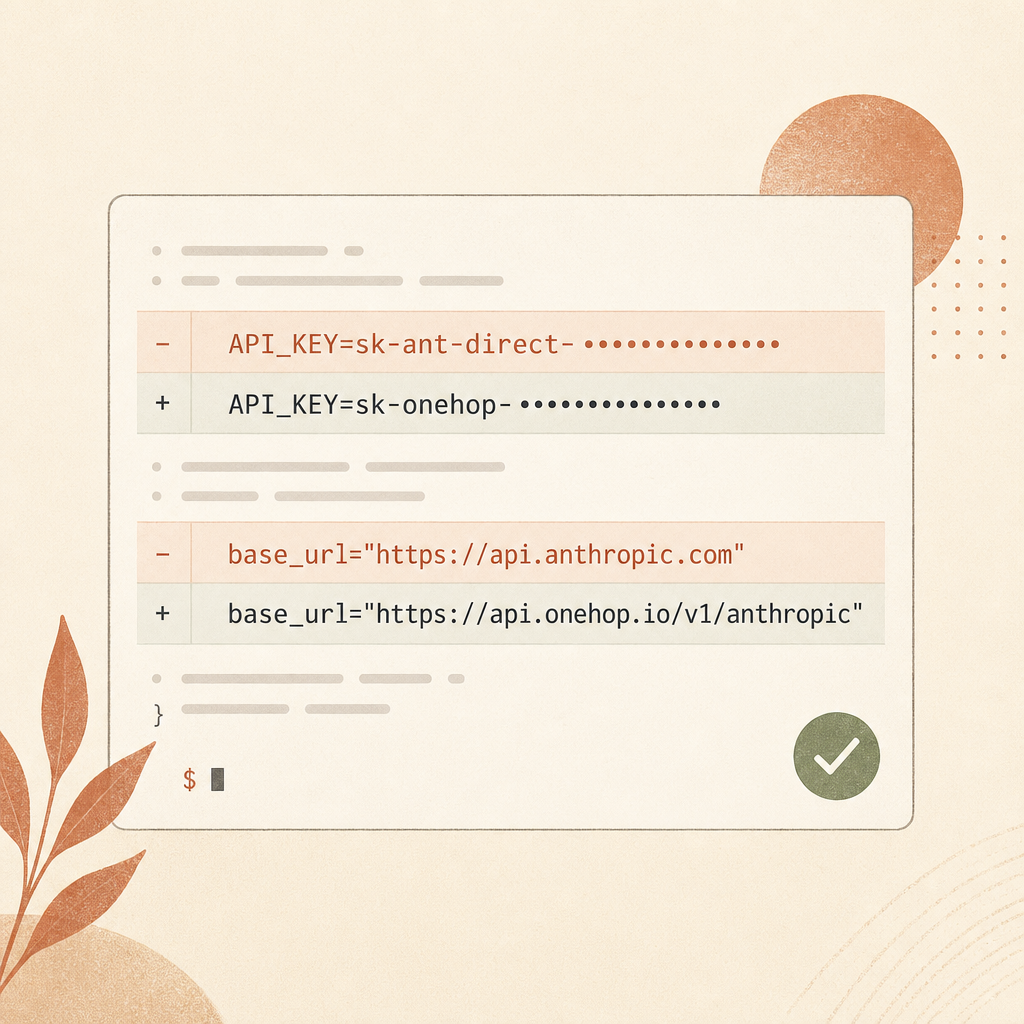
    base_url="https://api.onehop.ai/anthropic",
)

message = client.messages.create(
    model="anthropic/claude-fable-5",
    max_tokens=800,
    messages=[
        {
            "role": "user",
            "content": (
                "You are reviewing a Python web service. "
                "List the three highest-risk failure modes in its request pipeline "
                "and give one concrete test for each."
            ),
        }
    ],
)

print(message.content[0].text)
That is the real Anthropic SDK path shown on OneHop’s Claude Fable 5 page: https://api.onehop.ai/anthropic for Anthropic Messages streaming support (OneHop Fable 5). OneHop’s general OpenAI-compatible base URL is https://api.onehop.ai/v1 (OneHop), but for the Anthropic Python SDK, use the Anthropic-compatible base URL above. Mixing those up is the fastest way to get a confusing 404.
If your existing code reads configuration from the environment, the migration is even smaller:
client = Anthropic(
    api_key=os.environ["ANTHROPIC_API_KEY"],
    base_url=os.environ.get("ANTHROPIC_BASE_URL", "https://api.anthropic.com"),
)
Then run it through OneHop like this:
export ANTHROPIC_API_KEY="$ONEHOP_API_KEY"
export ANTHROPIC_BASE_URL="https://api.onehop.ai/anthropic"
Your call sites stay boring:
client.messages.create(
    model="anthropic/claude-fable-5",
    max_tokens=1024,
    messages=[{"role": "user", "content": "Refactor this API design for lower latency."}],
)
The official Anthropic SDK supports messages.create, streaming, token usage reporting, retries, and long request guidance in the Python SDK docs (Anthropic docs). OneHop is useful here because you are not replacing that surface area. You are changing where the HTTP request lands.
When a Gateway Helps, and When It Does Not
Use OneHop for Fable 5 when you care about speed of adoption. If your product already has an Anthropic abstraction, gateway access lets you test Fable behind a feature flag without touching business logic. You can route only the hard cases: multi-file code migrations, long-context analysis, expensive customer escalations, planning tasks that burn human hours.
It also helps when your team is juggling more than one model family. OneHop’s model page lists Anthropic, OpenAI, Google, DeepSeek, MiniMax, and others under one catalog (OneHop models). That matters in production because model choice stops being a philosophical argument and becomes a policy: cheap model for classification, mid-tier model for drafts, Fable 5 for tasks where failure costs more than tokens.
Do not use a gateway as a way to avoid understanding model behavior. Fable 5 has safety fallback behavior. It has 30-day data retention for safety monitoring according to Anthropic’s Fable page (Anthropic). It is expensive enough that unbounded agent loops can hurt. You still need request logging, budget limits, prompt caching for repeated context, and clear routing rules.
A sane starting policy looks like this:
| Workload | Suggested route |
|---|---|
| Classification, extraction, short JSON transforms | cheaper fast model |
| Normal code explanation or docs drafting | Sonnet/Opus-class route |
| Multi-step repo migration or hard debugging | Claude Fable 5 |
| Security, biology, chemistry-sensitive prompts | expect Anthropic fallback behavior |
| Reused long system prompts or docs | enable prompt caching where supported |
The key is to make Fable intentional. Treat it like a senior engineer’s time: do not spend it on every ticket, but do not hesitate when the work is actually hard.
Ship the Smallest Possible Migration
For a production rollout, I would make the gateway switch a config change, not a code fork.
Add three environment variables:
export ANTHROPIC_API_KEY="$ONEHOP_API_KEY"
export ANTHROPIC_BASE_URL="https://api.onehop.ai/anthropic"
export CLAUDE_MODEL="anthropic/claude-fable-5"
Then wire your app to those values. Keep the direct Anthropic endpoint as a fallback in staging until you have compared outputs, latency, and cost on your own prompts. Synthetic benchmarks are useful; your traces are better.
OneHop’s pitch is simple: reach Claude Fable 5 and other models through a gateway, keep the SDK you already know, and pay below list pricing while you test. For a developer team, that is the right kind of boring. One base URL in config, one model name, one smoke test.
Start with the model page here: Claude Fable 5 on OneHop. If you just want to run the code above without opening a billing discussion, start with $10 free.